

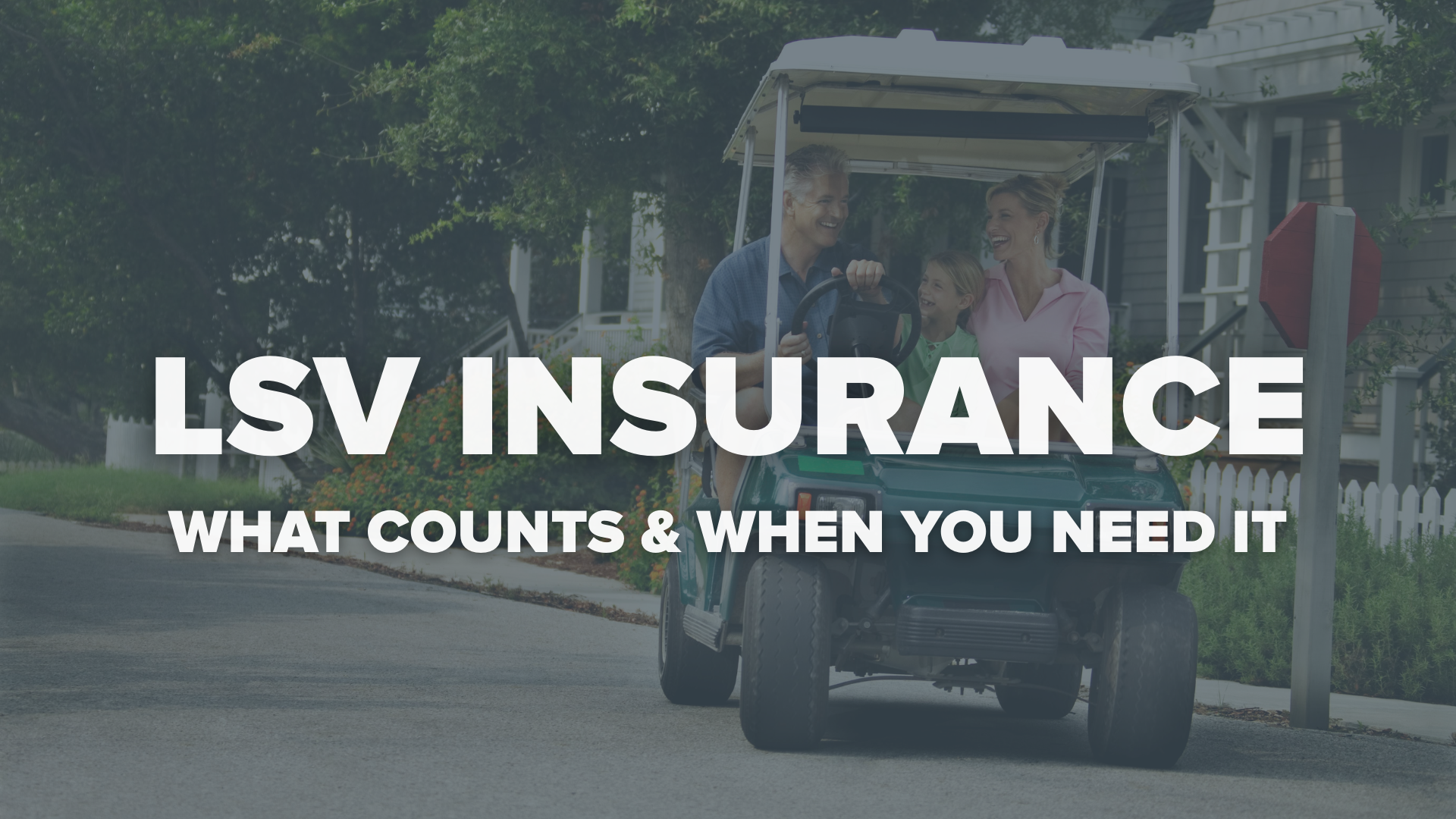
Low Speed Vehicle (LSV) Insurance: What Counts & When You Need It
Introduction: When “Slow” Vehicles Create Fast-Moving Problems
Golf carts. Neighborhood electric vehicles. Utility carts buzzing around a resort or HOA. They look harmless and “low risk” but one bad turn, one distracted driver, or one crowded event can turn a low speed vehicle into a high‑stakes liability problem.
Many people assume their homeowners or auto policy will cover these situations. Often, that assumption collapses at claim time. That’s the difference between cheap or “check‑the‑box” insurance and what we call TRU insurance – coverage designed to stand and fight when what can happen does happen.
XINSURANCE provides specialty insurance solutions for individuals, businesses, and organizations who:
- Own or operate low speed vehicles (LSVs)
- Have been denied, canceled, or non‑renewed
- Or suspect they have dangerous gaps in their current policies
In this guide, you’ll learn:
- What actually counts as a low speed vehicle (LSV)
- When you need low speed vehicle insurance and liability coverage
- Common real‑world low speed vehicle risk scenarios
- The key liability exposures that come with LSVs and golf carts
- Who needs specialty LSV insurance solutions (individuals, HOAs, resorts, campuses, and more)
- Why TRU insurance for LSVs matters more than cheap or “check‑the‑box” policies
- How Claims Direct Access powers a stronger, litigation‑ready claims process
- What a custom low speed vehicle specialty insurance solution can include
- How to get a quote and a policy review from XINSURANCE
- What to remember about slow vehicles and serious responsibility
- Answers to frequently asked questions about LSV insurance and liability coverage
What Is a Low Speed Vehicle (LSV)?
Low speed vehicles sit in a gray area between “car” and “golf cart,” which is exactly why they create so many coverage gaps.
The Federal Definition of Low Speed Vehicles (LSVs)
Under federal safety standards in the U.S., a low speed vehicle is generally defined as:
- A 4‑wheeled motor vehicle
- With a top speed typically between 20 and 25 mph
- Intended for use on roads with posted speed limits up to about 35 mph
However, states and local jurisdictions can refine this definition, add equipment requirements (lights, mirrors, seat belts, VIN, etc.), and decide where LSVs can legally operate. That means the exact rules for your LSV will depend on where you live or do business.
Common Types of Low Speed Vehicles
Examples of vehicles that may be treated as LSVs (depending on how they’re equipped and registered) include:
- Neighborhood electric vehicles (NEVs)
- Street‑legal golf carts modified with required safety features
- Resort or hotel shuttle carts used on public roads
- Utility or maintenance carts operating in campus or city environments
- Custom‑built electric buggies or converted LSVs
Not every golf cart is automatically an LSV, and not every LSV looks like a golf cart. The key issues are speed, equipment, registration, and where you drive it.
LSV vs. Golf Cart vs. NEV
- A golf cart may be designed mainly for golf courses or private property and may not be street legal.
- A neighborhood electric vehicle (NEV) is usually an electric LSV specifically designed for low‑speed, local transportation.
- An LSV is the broader regulatory category, and your state may classify some golf carts and NEVs as LSVs if they meet particular rules.
From a liability and insurance perspective, what matters most is:
- How the vehicle is classified and registered
- Where it is used (private property vs. public roads)
- Whether it is used for personal, commercial, or organizational purposes
When Do You Need Low Speed Vehicle Insurance and Liability Coverage?
The biggest mistake owners and businesses make with LSVs is assuming “it’s just a cart” and not a real vehicle. But when a claim hits, plaintiffs and their attorneys will treat it like a real vehicle and expect real money.
Legal Requirements: State & Local Rules
Some states require:
- Title, registration, and tags for LSVs
- Proof of financial responsibility or liability insurance similar to auto coverage
- Compliance with specific equipment standards (lighting, reflectors, windshield, etc.)
Others might:
- Allow certain LSVs only in restricted areas
- Limit operation to specific roads or communities
- Leave more discretion to local authorities and HOAs
Because laws vary, you should always check your state’s DMV or equivalent and local ordinances to understand minimum legal requirements. Remember: minimum legal is not the same as adequate protection.
Personal Use Scenarios Where You Need LSV Liability Coverage
Even if your state doesn’t strictly require separate low speed vehicle insurance, you can still face serious liability exposure, such as:
- Neighborhood accident: You’re driving your LSV to a friend’s house. A child on a bike darts out, and you can’t stop in time. Serious injuries, long‑term medical bills, and lawsuits follow.
- Passenger injury: A friend or family member falls out of your LSV while you’re turning. They suffer head or spinal injuries. Now you’re dealing with bodily injury claims and potential litigation, not just hurt feelings.
- Road crossing collision: You cross a busy street between two private properties and collide with a car that had the right of way. Property damage and injury claims may reach far beyond what you assumed.
In many cases, homeowners or standard auto policies may:
- Exclude vehicles designed for use off public roads
- Exclude vehicles not listed on the schedule
- Exclude business or rental use entirely
- Limit coverage to specific locations (e.g., on the insured premises only)
That’s how people end up more self‑insured than they realize.
Business & Organization Use: Higher Stakes, More Eyes on You
If you use LSVs for your organization, the stakes get even higher:
- Resorts & hotels: Guest shuttle carts, bell service carts, and rental carts around the property and onto nearby streets.
- HOAs & gated communities: Security, maintenance, and resident LSVs operating in shared spaces and on boundary roads.
- Universities & schools: Campus shuttles, maintenance carts, and event transportation.
- Event organizers: Parking lot shuttles, VIP rides, and vendor carts.
- Dealers & rental companies: Demo drives, test drives, and daily rentals to the public.
One serious injury can quickly become:
- A high‑dollar bodily injury claim
- Multiple claimants from a single incident
- Reputational damage in the community and online
- A coverage fight if your policy doesn’t clearly address LSVs
This is exactly where specialty LSV insurance solutions can help protect your balance sheet and your brand.
Real‑World LSV Risk Scenarios You Might Recognize
Here are some realistic situations that highlight why low speed vehicle liability coverage matters:
- Neighborhood Holiday Parade
- A decorated LSV pulling a small trailer hits a pothole. A child falls off the trailer and is badly injured.
- The driver thought a homeowners policy would respond. The carrier points to exclusions for motor vehicles and trailers involved in a parade.
- Resort Guest Cart Crash
- A guest at a coastal resort takes a branded LSV to a nearby restaurant. On the way, they collide with a bicyclist.
- The resort’s general liability policy contains exclusions for auto‑type exposures not scheduled, and the auto policy doesn’t list the LSVs.
- Campus Crosswalk Injury
- A maintenance LSV crosses a public road between two parts of a campus and strikes a pedestrian in a crosswalk.
- Questions arise: Is this a vehicle exposure under auto? Is it covered on the GL? Is the LSV even described in the policy?
- HOA “Friendly Lift” Gone Wrong
- A resident offers an elderly neighbor a ride in their golf cart‑style LSV. The neighbor falls while stepping off and breaks a hip.
- The HOA gets pulled into the lawsuit, plus the resident. Both are looking for coverage.
These are the kinds of situations where cheap or generic coverage often collapses and where a TRU insurance approach matters.
Key Liability Exposures for Low Speed Vehicles
With LSVs, think beyond dents and scratches. The bigger risks are:
- Bodily injury to passengers, pedestrians, cyclists, or other drivers
- Property damage to other vehicles, buildings, fences, landscaping, or infrastructure
- Vicarious liability for businesses, HOAs, and property owners whose employees, volunteers, or residents operate LSVs
- Non‑owned and borrowed LSVs (vehicles you don’t own but still control or allow on your premises)
- Rental and loaner operations where you put keys into the hands of customers or guests
- Event‑related exposures where higher foot traffic and distractions increase the risk of an incident
A well‑designed low speed vehicle insurance solution should be built around managing these real‑world exposures, not just satisfying the minimum proof‑of‑insurance requirement.
Who Needs Specialty Low Speed Vehicle Insurance Solutions?
You likely need specialized LSV coverage if any of the following apply:
Individuals
- You own an LSV, NEV, or golf cart used:
- In a neighborhood or gated community
- On public roads (even for short trips)
- To tow small trailers or carry passengers
- You have a lifted or modified cart or a custom LSV build
- You have had previous claims, or a carrier has denied, canceled, or non‑renewed your coverage
Businesses & Organizations
- Resorts, hotels, and vacation properties using LSVs for guest transport or rentals
- HOAs, condo associations, and master associations with shared LSV use or heavy resident cart usage
- Golf courses and country clubs that allow carts on public roads or run shuttle services
- Event organizers and venues using carts for shuttles, security, or VIP transport
- Colleges, universities, and schools with campus fleets crossing public roads
- Security and patrol companies using LSVs in neighborhoods, campuses, or business districts
- Property owners and managers where tenants or vendors frequently operate LSVs on-site
If you’re reading this and thinking, “I’m not sure if our LSVs are really covered,” that’s your red flag. That’s when a specialty partner like XINSURANCE becomes essential.
TRU Insurance for LSVs: There When It Counts
At XINSURANCE, we believe cheap or fake insurance is worse than no insurance at all because it creates a false sense of security. XINSURANCE provides specialty insurance solutions as a DBA of Evolution Insurance Brokers, LC (EIB), an excess & surplus lines insurance brokerage. We focus on:
- Individuals and businesses who are denied, canceled, non‑renewed, or told their risk is “too hard to place”
- Situations where standard policies leave dangerous exclusions and gaps
- Access to custom underwriting that looks at the full story, not just a score or a box to check
For LSVs, that means we can work with you to provide a custom solution that may address:
- Personal or commercial liability for LSV ownership and operation
- Higher limits (often up to $20M+, with higher limits available in some cases)
- All‑in‑one approaches that can consider multiple exposures (for example, premises liability plus LSV operations)
- Custom options like no deductible or risk‑sharing arrangements when appropriate and supported by underwriting
This isn’t about racing to the bottom on price. It’s about building a TRU insurance solution that’s designed to keep you from “feeding the lawyers” when an LSV claim hits.
Pro tip: You can send your current policy to XINSURANCE for a free review. We’ll help you identify exclusions and gaps that might affect your low speed vehicles.
How Claims Direct Access (CDA) Strengthens Your LSV Protection
Great underwriting doesn’t matter if the claims process falls apart. That’s why our TRU insurance promise includes a powerful claims partner: Claims Direct Access (CDA).
Who Is Claims Direct Access?
Claims Direct Access (CDA) is a licensed third‑party claims administrator (TPA) and an authorized claims‑handling partner for select specialty carriers.
Since 1994, CDA has:
- Resolved 70,000+ claims
- Handled matters in all 50 states and U.S. territories
- Built a reputation for litigation‑ready expertise and “results beyond the claim”
That experience matters when an LSV claim becomes complex, multi‑party, and multi‑jurisdictional.
Litigation‑Ready Claims Handling
LSV incidents can involve:
- Conflicting stories from drivers and witnesses
- Multiple injured parties
- Local rules and ordinances that complicate liability
- Coverage questions that need careful handling
CDA is equipped to:
- Handle complex, multi‑jurisdictional claims
- Manage coverage issues while contesting liability and damages
- Provide in‑person representation at mediations, settlement conferences, arbitrations, and trials
This is where TRU insurance shows up: not just paying claims, but fighting for fair outcomes.
Fast, Flexible Reporting & Communication
When something happens with an LSV, you don’t want to wonder if your message was received. CDA offers:
- Multiple reporting channels:
- Online claim forms
- Phone and email reporting
- After‑hours emergency claims phone for urgent events
- A mobile app that makes it easy to submit photos, videos, and statements from the scene
Throughout the process, CDA emphasizes:
- Frequent communication so you’re not left in the dark
- Clear next steps and expectations
- A focus on “results beyond the claim” considering long‑term impact, not just closing a file
When you pair custom low speed vehicle insurance solutions from XINSURANCE with CDA’s claims strength, you get more than a policy. You get a real partner at claim time.
What Can a Custom LSV Specialty Insurance Solution Include?
Every situation is different, and coverage is always subject to underwriting and policy language. But in general, a specialty LSV solution may be able to address:
- Liability for bodily injury and property damage arising from LSV use
- Personal use, commercial use, or a mix of both
- Hired and non‑owned LSV exposures (for rentals, borrowed vehicles, or guest carts)
- Property/physical damage coverage for the LSV itself (subject to eligibility and valuation)
- Additional insureds such as HOAs, resort owners, event venues, or landlords
- Custom limits, deductibles, and structure that fit your risk tolerance
Again, nothing is standard or guaranteed. This is custom, excess & surplus lines underwriting designed to solve problems the standard market often avoids.
How to Get a Quote for Low Speed Vehicle Insurance from XINSURANCE
It’s important to note that we can only offer quotes to clients who are within 30 days of their policy start date. If you’re looking to activate a policy beyond 30 days from now, we ask that you reach out to us closer to your desired start date.
Getting started to request your lsv insurance quote is straightforward. Click the “get started” button below and fill out the form that follows. We can also review your current policy at no charge, to help identify exclusions and gaps that might affect your LSV exposures.
If you are an insurance agent or broker:
- We’re agent‑friendly and can help you place difficult or unusual LSV risks
- Learn more at our agents page
Together, we’ll explore options for a TRU insurance solution built around your low speed vehicles, not just a generic box on a form.
LSV Insurance for Golf Carts
We provide LSV insurance solutions for all types of golf carts so if you need a quote, we can help!
Conclusion: Slow Vehicles, Serious Responsibility
Low speed vehicles may move slowly, but the financial and legal consequences of an LSV accident can move very fast.
If you:
- Rely on a golf cart or NEV for daily life
- Operate fleets of LSVs at a resort, HOA, campus, or event venue
- Have been denied, canceled, or non‑renewed by a standard carrier
- Or simply aren’t sure what happens if “something goes wrong” with your cart…
…it’s time to replace assumptions with a TRU insurance strategy.
XINSURANCE provides specialty insurance solutions that can help address your LSV risks with custom underwriting, higher limits, and a claims partner, Claims Direct Access, built for real‑world litigation.
Ready to talk about your LSV exposure? Contact XINSURANCE today to discuss a custom low speed vehicle insurance solution or to request a policy review.
FAQ: Low Speed Vehicle (LSV) Insurance
1. What qualifies as a low speed vehicle (LSV)?
+
Generally, an LSV is a 4‑wheeled motor vehicle with a top speed around 20–25 mph, designed for use on roads with lower posted speed limits (often up to 35 mph). Examples can include neighborhood electric vehicles and certain street‑legal golf carts. However, the exact definition and rules vary by state and local jurisdiction, so always check your local laws.
2. Do I really need insurance for my golf cart or LSV if I only drive in my neighborhood?
+
Possibly, yes. Even in a neighborhood, you can injure pedestrians, cyclists, or passengers, or damage property. Standard homeowners or auto policies may exclude motor vehicle exposures like LSVs, especially when driven off your premises or on public roads. Low speed vehicle insurance or LSV‑specific liability coverage can help close that gap.
3. Doesn’t my homeowners policy cover my golf cart?
+
Sometimes there is limited coverage, but there are often major limitations and exclusions, such as:
- Only on the insured premises
- Not for use on public roads
- Excluding business or rental use
- Excluding certain types of vehicles
Because every policy is different, the safest approach is to have a professional review your policy. XINSURANCE can review your current coverage and help identify gaps affecting your LSV.
4. I run a resort/HOA/campus with several LSVs. Do I need commercial LSV coverage?
+
Likely yes. When you use LSVs for guests, residents, students, or employees, you create a business or organizational exposure. General liability or commercial auto policies may not automatically cover LSVs unless they’re properly described and scheduled. A commercial LSV insurance solution can be critical to protecting your entity and any additional insureds (like property owners, HOAs, or sponsors).
5. Can XINSURANCE help if I’ve been denied or canceled for LSV coverage?
+
Yes. XINSURANCE provides specialty insurance solutions in the excess & surplus lines market and focuses on individuals and businesses who are denied, canceled, non‑renewed, or hard to place. If traditional carriers won’t insure your LSV use because of claims history, modifications, or unique operations, XINSURANCE may be able to help with a custom solution, subject to underwriting.
6. Are LSVs street legal everywhere?
+
No. Street legality depends on:
- Your state’s laws and regulations
- Local ordinances
- How the vehicle is equipped (lights, signals, mirrors, etc.)
- Whether it’s registered and titled correctly
Always check with your DMV and local authorities before operating an LSV on public roads.
7. How much LSV liability coverage do I need?
+
There’s no one‑size‑fits‑all answer. Factors include:
- How you use the vehicle
- Where you drive it
- Whether it’s personal, business, or rental use
- Your overall risk tolerance and assets to protect
XINSURANCE can help you explore custom limits, often up to $20M+ with higher limits available in some cases, depending on underwriting.
8. How are LSV claims handled with XINSURANCE?
+
If you are a client of XINSURANCE and a covered LSV claim occurs, Claims Direct Access (CDA), a licensed third‑party claims administrator, handles the claim. CDA has resolved 70,000+ claims nationwide and offers:
- Multiple ways to report claims (online, phone, email, app)
- After‑hours emergency claims support
- Litigation‑ready expertise, including in‑person representation at mediations, settlement conferences, arbitrations, and trials
The goal is frequent communication and results beyond the claim, not just a quick file closure.
9. Can my insurance agent work with XINSURANCE on LSV risks?
+
Absolutely. XINSURANCE is agent‑friendly. If you’re an agent or broker with a client who has a tough LSV risk – denied, canceled, non‑renewed, or highly customized – we can work with you to explore a specialty solution. Learn more here: insurance agents.
Important: This article is educational only. It does not modify any policy or guarantee coverage or eligibility. Actual coverage depends on underwriting and the specific terms and conditions of any policy issued. Review your policies carefully and speak with a licensed insurance professional about your situation.