

Common Causes of Small Plane Accidents
Accidents are a fact of life. Whether you’re driving a car or flying a small aircraft, some degree of risk is always there. When flying, the best you can do to prevent this risk from becoming a reality is to continually hone your skills, be relentlessly methodical, and exercise caution. The likelihood of a plane crash is much higher for small aircraft, so it’s helpful to understand the common causes of small plane accidents so you can avoid others’ mistakes.
1. Pilot Error
Most accidents are due to pilot error. Piloting a small aircraft is a complex task that presents many opportunities to make mistakes. These often occur during descent and landing, when the pilot must transition out of level flight, gradually lose altitude, approach the runway, and land. The next most likely time for an accident is taking off from the runway and climbing out. Weather effects such as poor visibility or high wind can further complicate takeoff and landing.
In the U.S., small planes fall under the general aviation category, along with gliders, balloons, and other small aircraft that amateur pilots use. The Federal Aviation Administration maintains a small airplane accident library to record crashes, causes, injuries, and fatalities. In 2022, a total of 358 people died in fatal general aviation airplane crashes in the U.S. Small plane crashes are less rare because they conduct over 23 million flight hours and land in over 9,200 airports globally, which makes them more prone to accidents.
Inexperience
Inexperienced pilots account for many small plane accidents, which might be due to overconfidence, which places them in situations that exceed their abilities. To become a certified pilot for general aviation aircraft, people don’t need to log as many flight hours as they would for commercial flying. Most private pilot certificates require at least 40 hours of flight training, while commercial pilot certificates often require 250 hours or more.
Some pilots confuse the time they’ve had a pilot’s license with practical flight hours. That is, they fly infrequently but overestimate their skills, which can make them do overambitious things.
Inflight Causes
Over the past 10 years, pilots losing control in flight was the leading cause of fatal plane crashes in the United States. Other common causes of fatalities associated with operator error include loss of control on the ground and controlled flights into the terrain. The latter occurs when the pilot cannot detect and react to an obstacle on the ground with enough time to avoid it. Inexperienced pilots tend to respond slower and less efficiently to these unexpected obstacles.
Preflight Causes
Inadequate preflight planning and inspection are other types of pilot error. While commercial airliner pilots have stringent procedures, the rules for general aviation are generally much looser. Mistakes, whether caused by distraction, complacency, or inexperience, may set the pilot up for an accident later in the flight. Common pilot errors include oversights such as running out of fuel, using the wrong fuel, overloading the plane, or taking off in a poorly balanced craft.
Running out of fuel is a common cause of crashes, leading to more than three accidents per week in the United States. Pilots may fail to check their fuel before they take off. Otherwise, they underestimate the fuel needed for a flight. When pilots run out of fuel, they can do nothing to avoid a crash.
2. Mechanical Error
While mechanical error from defective parts is not uncommon, it more likely results from failing to keep up with maintenance or disorganized maintenance record updates.
Poor Maintenance
The preflight inspection covers many vital components, such as the free movement of the elevator and rudder, flap and aileron integrity, tire condition, landing lights, and pitot tube. Treating this inspection as so much busywork can cause the pilot to overlook a severe mechanical problem.
Commercial airline pilots must follow specific laws and regulations that help ensure safe and efficient operation during flight. However, these rules do not usually apply to small planes. Instead, the preflight inspection depends on the pilot’s judgment and experience, meaning an inexperienced pilot could deem their aircraft airworthy despite significant oversights.
Sometimes, an accident happens because of an honest oversight of the pilot or a trusted employee. Even if they aren’t the sort of people to cut corners, the risk of a small plane accident will never be zero. It’s always there. When an accident happens, the pilot may be liable for what happens to the passengers or people on the ground.
Defective Parts
Small airplanes are more prone to mechanical faults due to the lack of regulatory equipment. Dangerous designs and defective parts may be the actual cause of some private plane crashes that are attributed to pilot error.
In 2024, after the fuselage and door plug of a Boeing 737 Max plane blew out, further investigations into other Boeing planes began. These investigations revealed that Boeing may have hidden faulty plane parts from the Federal Aviation Administration and later installed some of them on new planes.
While these planes are passenger planes, defects also arise in small aircraft. These defects create dangerous conditions during flight that could lead to fatal crashes. Defects in the surfaces of plane parts add significant stress, causing parts to break down more quickly than expected. While inspections can uncover these defects, they don’t catch every instance. Intentional coverups of defects also lead to more issues.
3. Weather
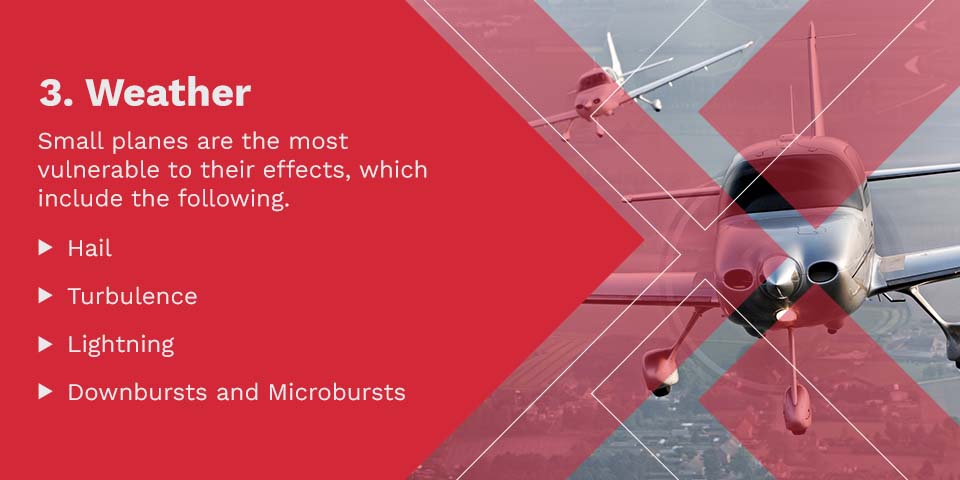
The third reason why airplanes crash is the weather. Poor weather brings many dangers to aircraft, increasing the difficulty of flying. Some of the risks include heavy rain, fog, lightning, and poor light, which decrease visibility, leading more pilots to crash into stationary structures like trees, buildings, or mountains.
Beyond lowering visibility, bad weather pushes aircraft around and causes damage to the exterior. While bad weather can happen any time of year, pilots face more danger during the warmer months.
Summer is when pilots like to enjoy the freedom of the skies with their small aircraft. The pilot need not worry about the snow and ice storms of winter. But summer brings the risk of thunderstorms, which are more likely to catch pilots off guard. Winter storms give more advance warnings because they take longer to develop and move slowly. By contrast, thunderstorms form rapidly, move fast, and grow quickly in size.
According to the Federal Aviation Administration (FAA), commercial flight delays hit almost 5,200 across Newark, LaGuardia, and Kennedy airports in May 2022. The principal reason is the convective weather associated with thunderstorms. Flying in a thunderstorm is as dangerous as flying in a hurricane, except hurricanes take time to gather strength and move in from somewhere else. Thunderstorms often pop up locally.
Whether you are taking people up for rides or are planning a cross-country adventure with a best friend, make sure you have all your liabilities covered. Anyone suffering injury or property loss as a result of a flying accident can take you to court. Don’t trust your financial well-being to luck because the dangers of summer flying are real. Thunderstorms are dangerous, frequent, and can catch you off guard.
Thunderstorms present the worst dangers to aircraft, both large and small. However, small planes are the most vulnerable to their effects, which include the following.
Hail
The strong updrafts associated with thunderstorms draw moisture high in the atmosphere where the temperature is below freezing. This moisture freezes and coalesces into hail, which can break windshields and cause other damage.
Turbulence
In thunderstorms, warm air rises upward, cools, and moves down. The mixture of upward and downward air currents creates turbulence that can tear airplanes apart. Turbulence can occur in the clear air near the storm, not only in the storm itself.
Lighting
Aircraft either have aluminum skin or use composite materials with conductive additives, which form a Faraday “cage” that directs lightning around and away from the plane. The plane and its occupants are generally safe because of this. However, some damage can occur at the entry and exit points of the lightning strike. Perhaps the most significant danger from a strike is its effects on the plane’s electrical systems and instruments.
Downbursts and Microbursts
Downbursts occur when a strong downdraft hits the ground and spreads out in all directions. Airplanes flying into the resulting horizontal wind flow experience strong wind shear. A microburst is like a downburst except that it affects a smaller area.
4. Wildlife Strikes
While most wildlife strikes only cause minimal damage to the airplane, some bird strikes pose a serious threat to the pilot’s physical and financial safety.
From 1988 to 2023, 126 airplanes were reported destroyed by wildlife strikes in the U.S. Small general aviation aircraft were the majority of those damaged beyond repair in these collisions. Over the past 35 years, the rate of damaging wildlife strikes in the U.S. has significantly increased at general aviation airports.
Airport grounds are an attractive habitat for many wildlife. Bird strikes cause the most damage to the plane’s engine or wing, usually during takeoff or landing. If a collision causes midair engine failure, the results can be hazardous for general aviation aircraft, which typically only have one engine.
Pilots may even lose total aircraft control, depending on the circumstances. The effect of an impact generally depends on the size of the bird vs. the size of the plane. A smaller aircraft is more likely to sustain structural damage to the windscreen, empennage, or control surfaces. Windshield penetration may also injure pilots, causing them to lose control of the plane.
5. Landing Conditions
Most small-plane accidents occur on the runway as a result of inadequate landing conditions. General aviation aircraft usually land at small general aviation airports that require pilots to land on unconventional runways, where they must perform riskier landing procedures.
Hazardous landing conditions may result from a few factors.
Poorly Designed Runways
Runway designs depend primarily on the surrounding area. Some airports must plan around mountains or bodies of water, creating awkward yet necessary designs for their runways. Other airports choose to create cramped spaces to fit more runways. These poorly designed runways often require pilots to make sharp turns to avoid various obstacles.
Defective Runway Materials
Runways need sufficient concrete for the load carried. If the materials are too weak to withstand the weight or the weather conditions, cracks will quickly form on the surface, making landings hazardous.
Inefficient Weather Treatments
Timely runway treatment is essential for regions with notoriously inclement weather. Crews must treat runways for various conditions, such as ice and snowpack. When treatment is slow and ineffective, some airports rely on constant closures and delays instead. Unpredictable weather conditions and poorly designed runways are a dangerous combination.
Runway Traffic Incursions
Incursions occur when an aircraft collides with another plane, a person, or an unauthorized vehicle. Numerous situations cause these types of small plane crashes. Air traffic controllers could improperly direct pilots to an active or obstructed runway. Pilot mistakes or another employee’s errors can also lead to damaging runway incursions.
Contact XINSURANCE for Pilot Liability Coverage Solutions

Pilot errors, mechanical faults, inclement weather, wildlife strikes, and unconventional landing conditions have contributed to small aircraft accidents worldwide. These factors may impact your flight at any time. Pilot liability insurance solutions may protect your financial well-being and your passengers in the event of a covered claim. For information about pilot liability insurance solutions and how they apply to your situation, contact us for a quote.
Last Updated on October 30, 2024
 Authored by Rick J. Lindsey, President, Chairman, and CEO of XINSURANCE
Rick J. Lindsey hails from Salt Lake City, Utah. He began working in the mailroom of his father’s Salt Lake City insurance firm, getting his introduction to the business that became his lifelong career. Rick J. Lindsey quickly rose through the ranks while working in nearly every imaginable insurance industry job. As an entrepreneur, specialty lines underwriter, claims specialist, risk manager, and a licensed surplus lines broker, Rick J. Lindsey is highly skilled in all levels of leadership and execution. As he progressed on his career path, Rick J. Lindsey discovered an urgent need for insurers willing to write policies for high-risk individuals and businesses. He was frequently frustrated that he could not provide the liability protection these entities desperately needed to safeguard their assets. He also formed the belief that insurance companies acted too quickly to settle frivolous claims. Rick J. Lindsey decided to try a different approach. He started an insurance company and became the newly formed entity’s CEO. This opportunity has enabled Rick J. Lindsey to fill a void in the market and provide a valuable service to businesses, individuals, and insurance agents who write high-risk business. XINSURANCE also specializes in helping individuals and businesses who live a lifestyle or participate in activities that make them difficult for traditional carriers to insure. If you’ve been denied, non-renewed, or canceled coverage, don’t give up quite yet. Chances are XINSURANCE can help.