

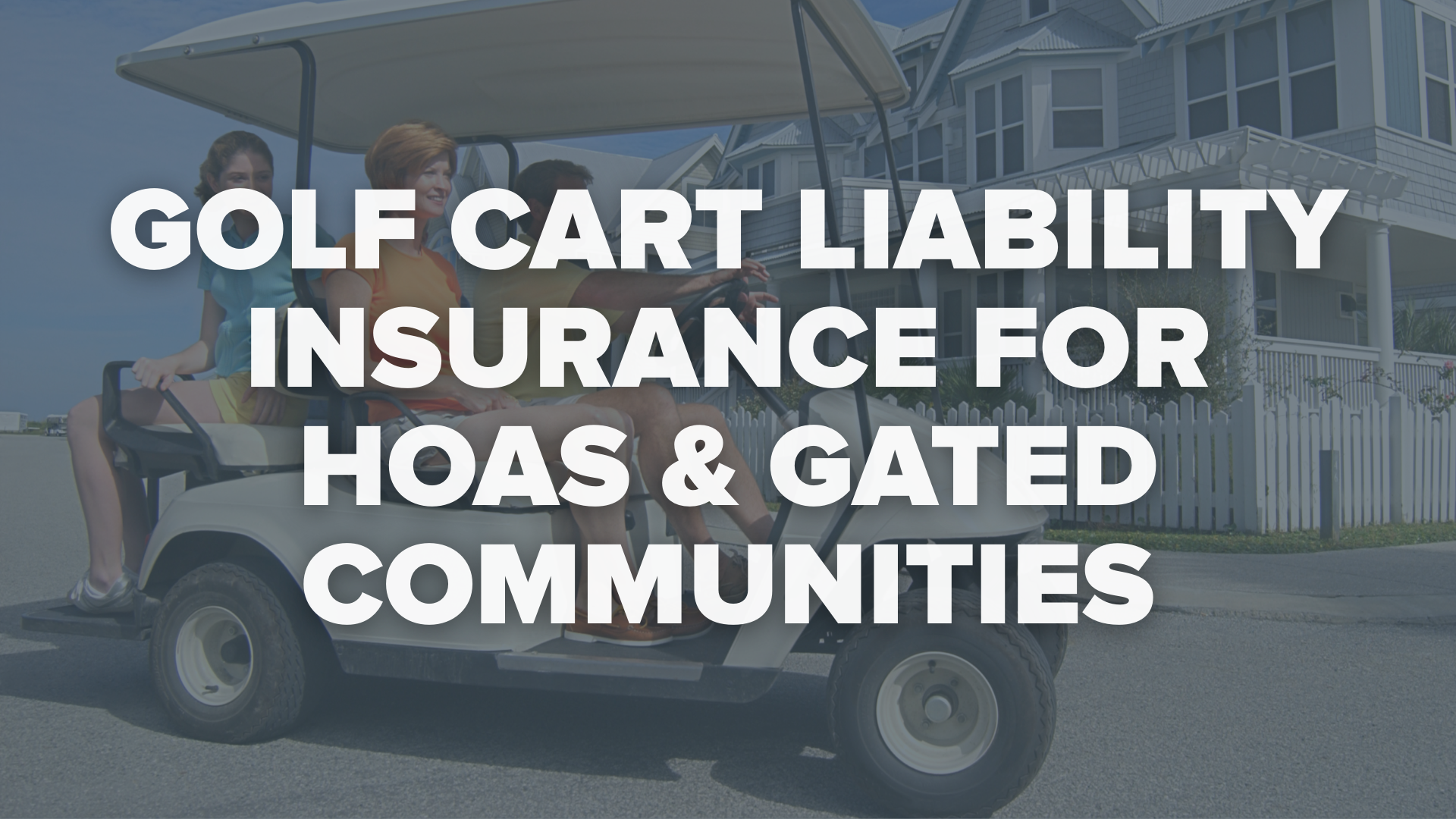
Golf Cart Liability Insurance for HOAs & Gated Communities: Risks, Coverage & TRU Solutions
Introduction: When Golf Carts Become a Community Liability
Tree-lined streets, quiet cul-de-sacs, and the hum of golf carts rolling to the pool or clubhouse – this is everyday life in many homeowners associations (HOAs) and gated communities. Golf carts and low speed vehicles (LSVs) are part of the lifestyle. They feel safe, familiar, and “low risk.”
But when a golf cart collides with a pedestrian, a parked car, or a child on a bike, the situation stops feeling low risk very quickly. Injuries, lawsuits, and finger-pointing can follow – and the HOA, board members, and individual residents may all get pulled into the claim.
Far too often, everyone assumes that the homeowners policy, the auto policy, or a generic HOA liability policy will handle it. At claim time, that assumption can collapse. That is the difference between cheap or “check-the-box” insurance and what we call TRU insurance – coverage designed to stand and fight when what can happen does happen.
XINSURANCE provides specialty insurance solutions for HOAs, gated communities, and individual residents who:
- Use golf carts or LSVs on community roads and common areas
- Have been denied, canceled, or non-renewed for golf cart or LSV coverage
- Suspect there are dangerous gaps in their existing HOA or personal policies
Important: This article is for general informational purposes only and does not constitute legal or insurance advice. It does not modify any policy or guarantee coverage or eligibility. Coverage depends on underwriting and the specific terms and conditions of any policy issued. Laws and regulations vary by state. Always review your policies and consult with a licensed insurance professional about your specific situation.
In this guide, you’ll learn:
- What golf carts really mean for HOA and gated community liability
- How HOA rules and state laws affect golf cart liability and coverage
- Real-world golf cart risk scenarios inside communities
- The key liability exposures HOAs and boards should understand
- Risk management tips to reduce golf cart incidents in your community
- Who needs specialty golf cart liability insurance solutions
- Why TRU insurance for golf carts matters more than cheap, generic coverage
- How Claims Direct Access (CDA) strengthens your golf cart claims process
- What a custom golf cart / HOA specialty insurance solution can include
- How to get started and request a quote
- Conclusion and next steps
- Answers to FAQs about golf cart liability insurance for HOAs
What Golf Carts Really Mean for HOA and Gated Community Liability
In many communities, golf carts have evolved from occasional conveniences into everyday transportation. Residents use them to:
- Visit neighbors, pools, clubhouses, and mail centers
- Access nearby shops or restaurants just outside the gates
- Move kids and guests around during events and holidays
- Support maintenance, security, and landscaping operations
Every time a cart moves, the HOA’s risk profile shifts. Why? Because:
- The HOA often controls or influences the environment (roads, signage, rules, enforcement)
- Golf carts mix with pedestrians, cars, delivery trucks, and cyclists
- Visitors, vendors, and children may not fully understand the hazards
Whether the carts are owned by the HOA, by individual residents, or by both, plaintiffs and their attorneys may argue that the HOA failed to set clear rules, enforce them, or design safe conditions – and they may go after the HOA’s assets and insurance limits.
How HOA Rules and State Laws Affect Golf Cart Liability and Coverage
Golf cart operations sit at the intersection of several rule sets:
- State and local traffic laws (including low speed vehicle regulations)
- HOA governing documents (CC&Rs, bylaws, rules and regulations)
- Insurance policy language (both HOA and individual residents)
State and Local Laws
States and municipalities may have rules covering:
- Where golf carts and LSVs can legally operate
- Required equipment (lights, mirrors, signals, seat belts, etc.)
- Age and licensing requirements for drivers
- Whether carts can cross public roads or travel on designated streets
Some golf carts are classified as low speed vehicles (LSVs) when equipped and registered to meet specific standards. These vehicles may be subject to additional requirements, including proof of financial responsibility or auto-type liability insurance.
Because rules vary by state and municipality, communities should review official sources such as their state’s Department of Motor Vehicles or transportation department for guidance.
HOA Governing Documents and Rules
Most communities address golf carts in their rules, for example:
- Limiting golf cart use to licensed drivers
- Requiring headlights or reflectors at night
- Restricting cart use on certain paths or common areas
- Requiring residents to carry their own golf cart liability coverage
However, simply having a rule is not the same as managing risk. If an HOA does not enforce its own policies – or if the rules are vague, outdated, or silent on key issues – the association can still be pulled into disputes after a serious golf cart incident.
Insurance Policy Language
On the insurance side, several policies might come into play:
- HOA master liability policy (general liability, umbrella, D&O)
- Individual homeowners policies
- Personal auto policies
The problem: many of these policies include exclusions or limitations for motor vehicles, off-road vehicles, or vehicles not listed on the policy. Some may provide only limited coverage on the “insured premises” and exclude use on community roads or public streets.
This is how HOAs and residents end up more self-insured than they realize when it comes to golf cart liability.
Real-World Golf Cart Risk Scenarios Inside Communities
To understand why golf cart liability insurance matters, it helps to look at realistic scenarios:
- Pool Parking Lot Collision
- A resident pulls a golf cart into a crowded pool parking lot. A child runs behind the cart, and the driver backs up without seeing them.
- The child is seriously injured. The parents sue the driver, the child’s guardians, and the HOA, asserting inadequate traffic controls and signage.
- Holiday Lights Tour Gone Wrong
- During a neighborhood holiday event, multiple carts travel in a line to view decorations. One driver is distracted, rear-ends another cart, and a passenger is thrown out.
- Multiple residents and their insurers argue over whose policy should respond – and whether the HOA is liable for organizing or promoting the event.
- Gate Crossing Accident
- A resident uses a cart to exit the community and cross a public road to a nearby shopping center. A vehicle with the right of way hits the cart in the intersection.
- The injured parties and their attorneys question whether the HOA knew this was happening and what, if anything, it did to warn or restrict residents.
- Maintenance Cart Pedestrian Injury
- An HOA-owned maintenance cart is driven along a narrow path. A pedestrian steps aside but loses footing off the edge, resulting in a fall and serious injuries.
- The HOA’s training practices, signage, and documentation quickly become a focus in the claim or lawsuit.
Each of these scenarios illustrates how quickly a “harmless” golf cart ride can become a complex, high-stakes liability event involving multiple parties and different policies.
Key Golf Cart Liability Exposures for HOAs and Boards
With golf carts, the obvious risk is collisions. But from an HOA’s perspective, the exposures are broader:
- Bodily injury to residents, guests, children, pedestrians, cyclists, or drivers of other vehicles
- Property damage to vehicles, buildings, landscaping, and common area structures
- Vicarious liability for employees, volunteers, or contracted security or maintenance staff using carts on behalf of the association
- Non-owned cart exposure when residents or guests operate their own carts on HOA roads and common areas
- Event-related exposures during parades, community celebrations, or social events where carts are heavily used
- Board and management decisions around rules, enforcement, signage, training, and risk communication
A well-designed golf cart liability insurance strategy should account for both HOA-owned carts and resident-owned carts, as well as the decisions and actions of the board and management.
Related: If your community includes short-term rentals that provide golf carts to guests, that creates a different set of risks. Read our guide: Vacation Rental Golf Cart Insurance: Liability Risks for Hosts and Property Managers.
Risk Management Tips to Reduce Golf Cart Incidents in Your Community
Insurance is one part of protection. The other part is reducing the chance of an incident in the first place. These practical steps can help HOAs, boards, and community managers reduce golf cart risk.
Note: This section is general education only and not legal advice. Requirements and best practices vary by location and community rules.
1) Tighten your community rules (and enforce them)
- Set minimum driver age and licensing requirements consistent with local rules.
- Limit drivers to residents and authorized guests. Clarify whether visitors can operate carts.
- Set passenger limits based on seating capacity. No extra riders or standing riders.
- Make impaired driving a zero-tolerance rule for community events and daily use.
2) Control where carts can operate
- Define approved routes, paths, and restricted areas (playgrounds, sidewalks, narrow trails).
- Clarify road crossing rules and high-risk intersections. Add signage where needed.
- Set night driving rules. If allowed, require lights and reflectors.
3) Improve visibility and traffic controls
- Add speed limit signage in high foot-traffic areas (clubhouse, pool, mail center).
- Mark pedestrian crossings and cart routes where possible.
- Use mirrors, reflectors, and lighting in blind corners or narrow paths.
4) Require basic safety standards for resident-owned carts
- Encourage or require lights, reflectors, and mirrors for carts used at dusk or night.
- Consider registration stickers or ID tags to discourage unauthorized use.
- Document violations and repeat offenders so enforcement is consistent.
5) Maintain HOA-owned carts like safety equipment
- Before use: check brakes, steering, tires, and lights.
- After incidents: remove carts from service until inspected and repaired.
- Keep a maintenance log with dates and repairs.
6) Create an incident response plan
- For injuries, call 911 immediately.
- Document photos of the scene, cart condition, and location.
- Record driver name, witnesses, and what happened while details are fresh.
- Notify the HOA management team and document a timeline.
These steps cannot eliminate risk, but they can reduce avoidable incidents and help your community show responsible operations if a claim occurs.
Who Needs Specialty Golf Cart Liability Insurance Solutions?
Specialty solutions become critical when the risks are real but the standard market will not fully address them – or when the HOA wants a TRU insurance approach instead of just the cheapest option.
HOAs and Gated Communities
- Communities where golf carts or LSVs are common for daily transportation
- Associations that own or operate carts for maintenance, security, or amenities
- Communities with paths, road crossings, or access points to nearby public roads
- HOAs that have experienced prior cart-related incidents or close calls
- Associations whose carriers have excluded or restricted golf cart coverage
Individual Residents
- Residents who use carts frequently on HOA roads or to access nearby businesses
- Owners of modified, lifted, or custom carts that may be treated as LSVs
- Individuals who have been denied, canceled, or non-renewed for golf cart or LSV coverage
Property Managers and Management Companies
- Firms that manage multiple communities where golf cart usage is common
- Companies concerned about being drawn into claims because of operational control
If you find yourself wondering, “Are our golf carts really covered – or are we exposed?”, that is your signal to take a closer look. This is where a specialty partner like XINSURANCE can help.
TRU Insurance for Golf Carts: Beyond Cheap or “Check-the-Box” Coverage
At XINSURANCE, we believe cheap or fake insurance is worse than no insurance at all because it creates a false sense of security. Policies full of exclusions and gaps may not show their weaknesses until claim time – exactly when your community needs them most.
XINSURANCE provides specialty insurance solutions as a DBA of Evolution Insurance Brokers, LC (EIB), an excess and surplus lines brokerage. We focus on:
- HOAs, gated communities, and individuals who are denied, canceled, or non-renewed
- Risks that standard carriers view as “too hard to place” or outside their appetite
- Helping clients access specialty markets where underwriting can consider the full story – not just a checklist or score
For golf carts and LSVs, our TRU insurance approach may consider helping you find access to a custom plan through specialty markets that may address:
- Liability coverage for HOA-owned carts and community operations
- Coverage for non-owned carts used on HOA premises or during community events
- Higher limits (often up to $20M+, with higher available in some cases, depending on underwriting)
- All-in-one approaches that can consider multiple exposures (for example, premises liability plus golf cart operations)
- Options like no deductible or risk-sharing arrangements when appropriate and supported by underwriting
Coverage options, limits, and terms vary by carrier and are subject to underwriting and policy language.
This is not about racing to the bottom on price. It is about building a TRU insurance solution designed to help your community avoid “feeding the lawyers” when a serious golf cart claim hits.
Pro tip: You can send your current HOA and personal policies to XINSURANCE for a free review. We can help you identify exclusions and gaps that might affect your community’s golf cart exposures.
How Claims Direct Access (CDA) Strengthens Your Golf Cart Protection
Great coverage placement means little if the claims process falls apart. That is why TRU insurance thinking includes claim-time strength, not just paperwork. Our approach includes a powerful claims partner: Claims Direct Access (CDA).
Who Is Claims Direct Access?
Claims Direct Access (CDA) is a licensed third-party claims administrator (TPA) and an authorized claims-handling partner for select specialty carriers. Since 1994, CDA has:
- Resolved 70,000+ claims
- Handled matters in all 50 states and U.S. territories
- Built a reputation for litigation-ready expertise and “results beyond the claim”
This depth of experience matters when a golf cart incident leads to complex, multi-party disputes involving residents, guests, vendors, and the HOA.
Litigation-Ready Claims Handling
Golf cart claims can involve:
- Conflicting stories from multiple residents and witnesses
- Serious bodily injuries and long-term medical needs
- Questions about rules, enforcement, and signage
- Coverage disputes across several different policies
CDA is equipped to:
- Handle complex, multi-jurisdictional claims
- Manage coverage issues while actively contesting liability and damages where appropriate
- Provide in-person representation at mediations, settlement conferences, arbitrations, and trials
This is where TRU insurance shows up – not just paying claims, but fighting for fair outcomes with litigation-ready expertise.
Fast, Flexible Reporting and “Results Beyond the Claim”
When something happens in your community, you do not want to wonder if your message was received. CDA offers:
- Multiple reporting channels:
- Online claim forms
- Phone and email reporting
- An after-hours emergency claims phone for urgent events
- A mobile app for fast submission of photos, videos, and statements from the scene
Throughout the process, CDA focuses on:
- Frequent communication so you are not left in the dark
- Clear next steps and expectations
- A mindset of “results beyond the claim” – considering long-term community impact, not just closing a file
Claims handling depends on the policy and carrier. If you are a client of XINSURANCE and a covered claim occurs, claims may be handled by CDA depending on the program and policy terms.
What Can a Custom Golf Cart / HOA Specialty Insurance Solution Include?
Every community and resident is different, and coverage is always subject to underwriting and the specific policy language. In general, a specialty solution placed through excess and surplus lines markets may consider:
- Liability coverage for bodily injury and property damage arising from golf cart or LSV use
- Coverage for HOA-owned carts and non-owned carts operated on HOA premises
- Protection for community events where cart usage increases risk
- Higher liability limits tailored to your association’s risk profile
- Options to add additional insureds (for example, management companies, property owners, sponsors)
- Integrated coverage approaches that look beyond carts to the broader liability landscape
Coverage options, limits, and terms vary by carrier and are subject to underwriting and policy language.
How to Get a Quote for Golf Cart Liability Insurance from XINSURANCE
It is important to note that we can only offer quotes to clients who are within 30 days of their policy start date. If you are looking to activate coverage beyond 30 days from now, please reach out closer to your desired start date.
Getting started is straightforward. Click the “Get Started” button below and complete the form that follows. You can also send your current policies for a free review so we can help identify exclusions and gaps that may affect your community’s golf cart exposure.
If you are an insurance agent or broker:
- We are agent-friendly and can help you place difficult or unusual HOA and golf cart risks
- Learn more at our insurance agents page
To learn more about this risk class, visit our golf cart insurance page. If you prefer to speak with our team, visit our contact us page. If you currently have a policy, we can review it and identify any gaps or exclusions that are leaving you exposed, for free!
Conclusion: Small Vehicles, Big Responsibility for HOAs
Golf carts may move slowly, but the legal and financial consequences of a serious cart accident can move very fast. As golf carts and LSVs become part of daily life in HOAs and gated communities, the risks and expectations placed on boards and managers increase.
- If your community relies on golf carts every day
- If you have HOA-owned carts for maintenance, security, or events
- If you have been denied, canceled, or non-renewed for cart coverage
- If you are not sure what happens when “something goes wrong”
It is time to upgrade from assumptions and cheap coverage to a TRU insurance strategy.
FAQ: Golf Cart Liability Insurance for HOAs and Gated Communities
1. Does our HOA’s general liability policy automatically cover golf cart accidents?
+
Not necessarily. Some policies may offer limited coverage for certain motorized vehicles, while others include exclusions for golf carts, LSVs, or vehicles not listed on the policy. Coverage can also depend on who owns the cart and where it is being driven. The only way to know for sure is to review your policy and talk with a licensed insurance professional.
2. If residents own their own golf carts, why should the HOA worry about insurance?
+
Even when residents own the carts, HOAs can be pulled into claims alleging inadequate rules, poor enforcement, or unsafe conditions. Plaintiffs often name multiple parties, including the association, board members, and management. That is why associations should think about both resident-owned and HOA-owned cart exposures.
3. Are golf carts considered low speed vehicles (LSVs) under the law?
+
Some golf carts may be classified as low speed vehicles if they are equipped and registered to meet certain standards (for example, lights, signals, mirrors, and other safety features). LSVs may be subject to additional legal requirements, including where they can be driven and whether financial responsibility (insurance) is required. This varies by state and locality, so check local rules.
4. Our community only uses carts on private roads. Do we still need golf cart liability insurance?
+
Yes. Private roads can still be the scene of serious injuries and property damage. The fact that the roads are private does not prevent claims or lawsuits. Residents, guests, delivery drivers, and service providers can all be affected. A dedicated strategy for golf cart liability can help protect your association and its members.
5. What limits should our HOA consider for golf cart liability?
+
There is no one-size-fits-all answer. Factors include community size, cart usage frequency, the number of carts, traffic patterns, and your risk tolerance. XINSURANCE can help clients explore access to higher-limit options, often up to $20M+ with higher limits available in some cases, subject to underwriting and policy terms.
6. Can XINSURANCE help if we have been denied or non-renewed for golf cart coverage?
+
Yes. XINSURANCE provides specialty insurance solutions in the excess and surplus lines market for individuals and entities that are denied, canceled, non-renewed, or considered hard to place. Availability depends on underwriting and the specific risk.
7. How are golf cart claims handled if we work with XINSURANCE?
+
Claims handling depends on the policy and carrier. If you are a client of XINSURANCE and a covered claim occurs, claims may be handled by Claims Direct Access (CDA), a licensed third-party claims administrator, depending on the program and policy terms. CDA offers multiple ways to report claims and emphasizes frequent communication, litigation-ready expertise, and results beyond the claim.
8. Can our insurance agent work with XINSURANCE on our HOA’s golf cart risks?
+
Absolutely. XINSURANCE is agent-friendly. If you are an agent or broker with a tough HOA or golf cart risk – denied, canceled, non-renewed, or highly customized – we can help you explore specialty solutions. Learn more at our insurance agents page.
9. Does this article guarantee that our HOA has or can obtain coverage?
+
No. This article is for educational purposes only and does not modify any policy or guarantee coverage or eligibility. Actual coverage depends on underwriting and the specific terms and conditions of any policy issued. Review your policies carefully and speak with a licensed insurance professional about your exact situation.