


Concealed Carry Accidental Discharge: What You Need to Know
Understanding the Risks and Responsibilities of Concealed Carry
In the United States, 46,728 people died from firearm injuries in 2023, according to the U.S. Centers for Disease Control and Prevention (CDC). But how common are accidental discharges?
More than a few of those cases involve accidents. Over a period of 5 years, unintentional firearm discharges resulted in 2,491 deaths nationwide. That figure may sound small, but it amounts to about 500 accidental gun deaths a year, as well as many more injuries. That means more than one person dies from an unintentional firearm discharge every day.
In many ways, accidental firearm discharge is a public health issue — it affects the health and safety of a significant portion of our population. Fortunately, you can take several steps to help protect against accidental discharge and avoid these highly preventable injuries.
Is an Accidental Discharge of a Firearm Illegal?
The legal consequences of accidental discharge vary based on the state and the circumstances. Criminal offenses most often occur when people act carelessly when handling a weapon. Charges could include:
- Negligent discharge: Failing to take proper care when using a firearm could lead to this criminal charge.
- Reckless discharge: This criminal offense involves a conscious disregard for the risk, leading to higher consequences than negligent discharge.
- Involuntary manslaughter: If reckless discharge results in death, an individual could be charged with this offense.
The penalties for an accidental discharge could also vary depending on the state and case, from fines to jail time. For example, negligent discharge consequences are usually less severe than those for other criminal charges. Even in cases without criminal charges, someone could file a civil lawsuit for property damage or bodily injury.
Common Causes and Prevention Strategies for Accidental Discharges
Let’s look at several concealed carry statistics before discussing accidental discharges. Over the past few decades, the number of concealed carry permits has soared. In 2007, the number of concealed handgun permits in the United States was a relatively modest 4.6 million. As of 2023, that number has climbed to 21.46 million — and some states do not require permits for concealed carry.
Concealed carry accidental discharge statistics are not readily available. The research organization known as the RAND Corporation investigated the correlation between shall-issue concealed carry permit laws and unintentional injuries and deaths and found the evidence too inconclusive to draw meaningful inferences from.
Nevertheless, accidental or negligent discharge of a firearm is a possibility with concealed carry. Let’s explore a few of the reasons.
1. Inexperience
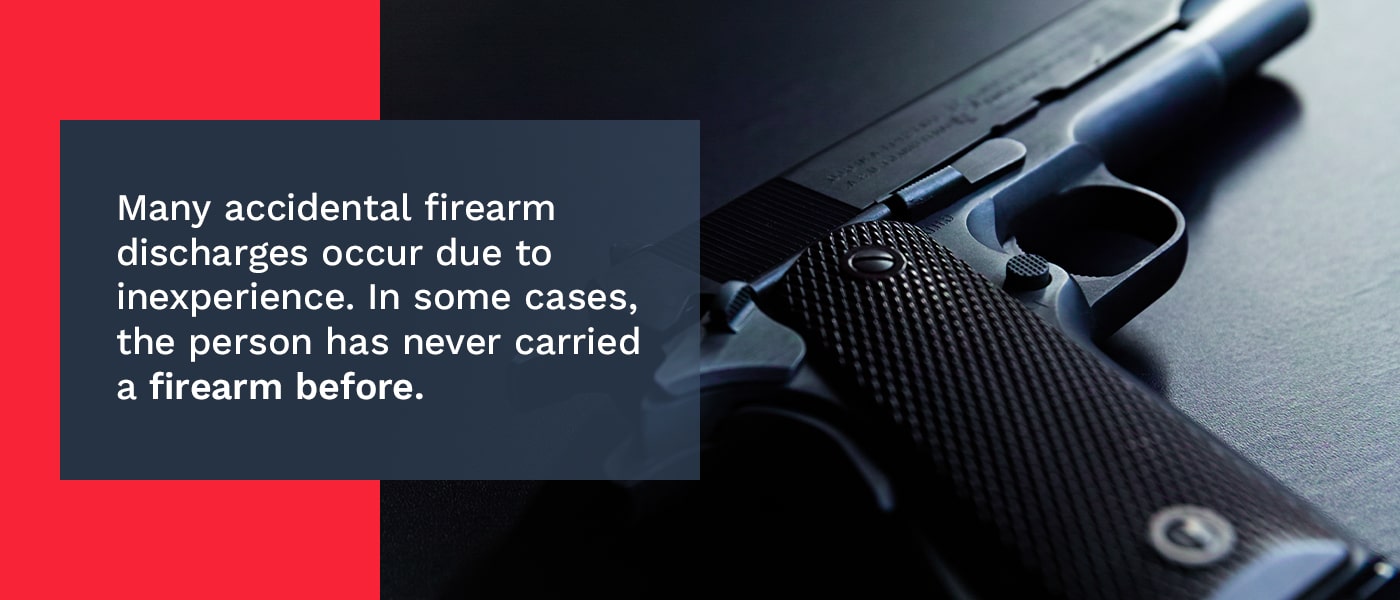
Many accidental firearm discharges occur due to inexperience. In some cases, the person has never carried a firearm before. In others, the person has a little firearm experience — perhaps just enough to feel confident — but insufficient to ensure competence with safe concealed carry. The person may never have taken a formal firearms training course.
It is no coincidence that the highest rate of death for accidental gunshot victims is for those aged 18 to 24. The shooter is usually someone about the victim’s age — so also relatively young and likely inexperienced. Being careful with concealed weapons is critical around children and young adults, especially in America’s schools. That is why many school communities prohibit weapons on their grounds.
A person without proper experience with concealed weapons may fail to take the necessary security measures. They may unholster their guns and place them in areas where they could easily fall, discharge, and hurt someone. Or they may intend to engage the safety catch but forget to do so.
That inexperience can come to light in various circumstances, such as when someone reaches into a purse or pocket, grasping the gun and causing it to go off. These incidents may also happen when individuals drop handguns accidentally. Accidental discharges may occur when handling weapons at home, such as while cleaning them.
More experienced firearm owners know how to avoid these potentially costly and tragic errors.
2. Improper Storage
Improper storage might occur if someone carrying a concealed weapon removes it and temporarily stores it elsewhere.
Some gun owners unholster their firearms and put them in unsafe places while they use the restroom. A person might put the weapon on top of the toilet paper dispenser or on the back of the toilet, where it could become unbalanced, fall, and accidentally discharge.
Improper storage can also mean failing to wear a holster during concealed carry. Some firearm owners merely tuck their guns into their waistbands. However, using a proper holster can be safer because holsters prevent accidental trigger contact.
Inadvertent gun discharges can still sometimes occur with holsters — if something gets stuck inside and interferes with the trigger, for instance. In general, though, holsters are designed to protect against these concealed carry accidents.
If you choose not to stow your gun in a holster for concealed carry, consider investing in a quality trigger shield to protect against accidental discharge.
3. Carrying While Under the Influence
Carrying a firearm while under the influence of alcohol or drugs can dramatically increase the chances of an accidental discharge. Almost a quarter of all unintentional firearm deaths involve alcohol consumption. Among individuals aged 20 to 29, that figure rises to 46.8%.
A person who has consumed an alcoholic beverage or several is much more likely to fumble with their weapon and drop it in a way that could cause it to discharge. Someone under the influence might also accidentally pull the trigger and injure or kill another person.
4. Using the Wrong Weapon for the Experience Level
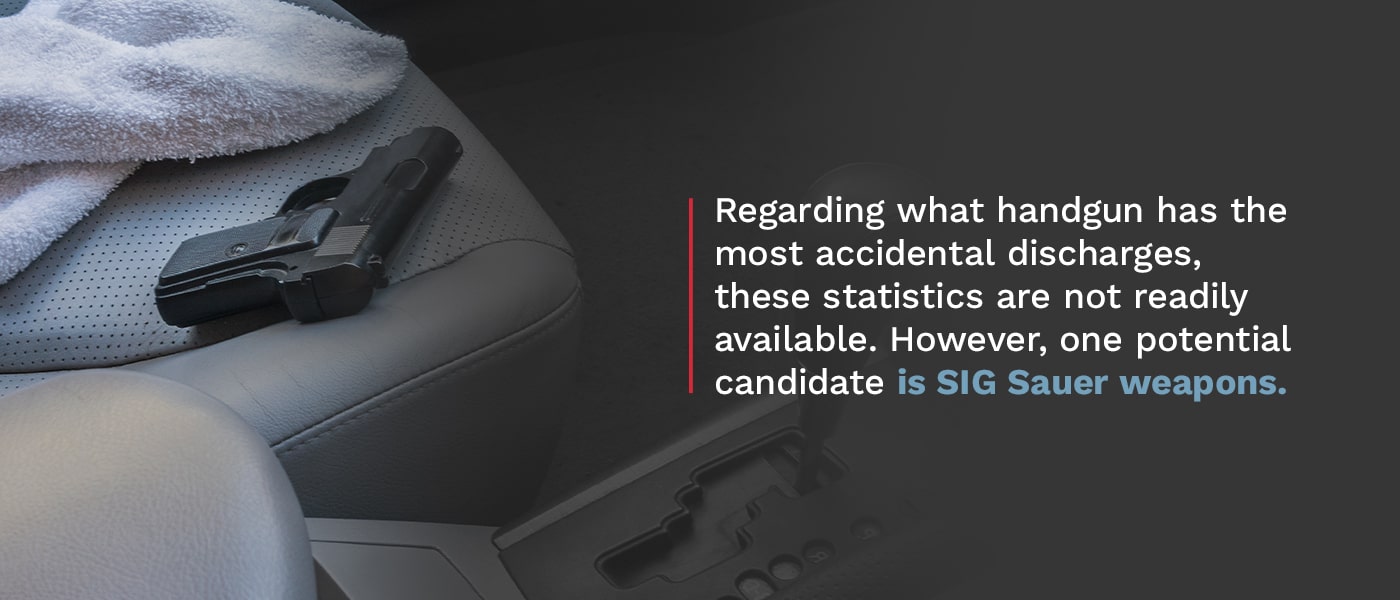
Regarding what handgun has the most accidental discharges, these statistics are not readily available. However, one potential candidate is SIG Sauer weapons.
SIG Sauer is an elite German handgun brand popular with law enforcement and military personnel. The gun’s design and function are optimized for use by these highly trained professionals. They need to be able to discharge their weapons quickly, often at a split-second’s notice, and they have the training and expertise necessary to manage firearms safely. SIG Sauers give them the precision and split-second response they need to do their jobs effectively and save lives.
SIG Sauer firearms have several features designed to make them easier for law enforcement officers to use:
- The absence of manual safety mechanisms on certain models
- Some of the lightest pull triggers available
- An unlabeled decocking lever, even though the decocking lever is necessary for disengaging single-action mode
In the hands of less experienced civilians, however, the same features can prove deadly. A civilian without the training to manage a hair-trigger response may become more prone to accidentally discharging the weapon.
Numerous inadvertent SIG Sauer discharges have occurred over the years. Some police officers have accidentally caused their SIG Sauer weapons to discharge when they dropped them or while holstering them. These incidents are hardly limited to law enforcement personnel. Civilians who own SIG Sauers have accidentally discharged them as well.
More rigorous research is likely necessary to determine which firearms are more susceptible to accidental discharge and at what rates. However, the most important thing is to know how accidental discharges are likely to occur, how to prevent them, and how to protect yourself from liability if they do occur despite your best efforts.
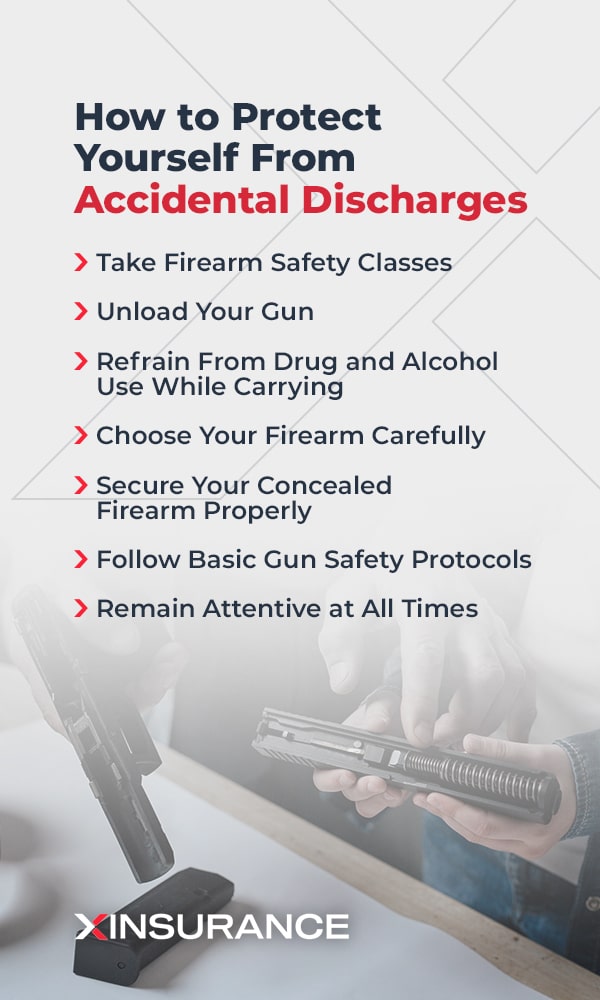
How to Protect Yourself From Accidental Discharges
Below are a few ways to prevent accidental concealed carry discharges:
1. Take Firearm Safety Classes
One of the best ways to protect yourself from accidentally discharging your concealed weapon is to take formal training in the use of a firearm. According to the RAND Corporation, about 61% of gun owners in the United States have received some formal firearms training. A safety class helps you learn the best techniques for securing and carrying a gun to make accidents less likely.
Firearms courses generally cover many basic safety protocols necessary to protect the gun owner and other people. Most firearms instructors cover topics like these:
- Proper firearm storage
- Loading and unloading the weapons
- Operating the safety mechanism
- Safely clearing cartridges and jams
- Avoiding accidental discharges by keeping the trigger finger away from the trigger until the person is ready to fire
This instruction can make the difference between safe gun carrying and carrying situations that could endanger other people.
2. Unload Your Gun
Some firearm owners prefer to carry loaded weapons. After all, loading a gun takes time, and having to stop and load could significantly slow a person’s reaction in an active shooter scenario.
However, carrying an unloaded gun is often the safest option. An unloaded weapon is guaranteed not to cause injuries or fatalities, even if you drop it or jostle it in a way that accidentally engages the trigger. Even if you forget to engage the safety catch on an unloaded weapon, you can still be sure your gun will not fire and hurt someone.
3. Refrain From Drug and Alcohol Use While Carrying
As we’ve seen, firearms and drug and alcohol use do not mix well. To minimize the likelihood of accidentally discharging your weapon and potentially injuring or killing someone, you should always remain sober when you have a loaded firearm on your person.
If you are carrying a concealed weapon and find yourself in a situation where you feel inclined to partake of mind-altering substances, you have a few options at your disposal. You can abstain, of course. You can unload your weapon before you begin to partake, or you might remove your gun and give it to a trusted friend or family member. Just be sure that the person has the good judgment and firearms experience necessary to remain safe.
4. Choose Your Firearm Carefully
Many people who carry concealed firearms want to know they are armed with superior protection. They want quality firearms they can rely on if they ever need them in a dangerous situation.
Nevertheless, gun owners should be responsible with their weapon choices. Individuals who do not have rigorous training with highly responsive firearms designed for law enforcement should be realistic about their ability to handle these guns safely. Choosing a weapon that requires slightly more force to engage the trigger can mean the difference between carrying safely and responsibly or potentially causing a tragic accident.
Discover Comprehensive Coverage Options
5. Secure Your Concealed Firearm Properly
One simple but effective way to prevent accidental discharges is to secure your concealed gun carefully whenever you carry it. Merely sliding your weapon into your waistband, for example, increases the likelihood that it will easily slip and fall out or that you will accidentally press against and engage the trigger.
To decrease that risk, consider using a holster for your weapon. If you do, ensure nothing inside could come into contact with the trigger.
Securing your firearm properly also applies when you must remove your concealed weapon from its usual place on your body. If you need to use the restroom, secure your gun so it cannot fall and discharge. If you set your weapon down somewhere, always choose a broad, flat, stable surface to minimize the risk that your gun could slip off and fire upon impact with the ground.
6. Follow Basic Gun Safety Protocols
If you carry a concealed weapon, you may draw it at some point. If you do, be sure to follow basic gun safety protocols:
- Never point your gun unless you intend to fire it.
- Be mindful of your target and everything behind it.
- Keep the safety catch engaged until you are ready to fire.
- Keep your finger away from the trigger until you are ready to fire.
Following these rules can help ensure you refrain from inflicting harm on an innocent bystander, even during times of stress.
7. Remain Attentive at All Times
Some accidental discharges occur even when well-trained gun owners become distracted. Even a momentary lapse in attention could lead to an accident. A distracted person carrying a weapon could brush against the trigger or move in a way that causes the gun to fall and fire. A distracted person who is carrying a loaded weapon but usually carries an unloaded weapon might forget to be very careful with the loaded gun.
Maintaining attentiveness and vigilance at all times during concealed carry is critical. It enables gun owners to carry their weapons responsibly without doing grievous harm to those around them.

Top 5 Mistakes to Avoid if You Are a Gun Owner
There has been an unprecedented increase in gun owners in recent times, the primary reason being the protection of oneself and loved ones. A recent survey from the Pew Research Center indicates that about 42% of Americans live in a household that owns a gun.
As per the Second Amendment to the Constitution, owning a gun in the United States of America is any civilian’s fundamental right. However, this right also requires you to exhibit great responsibility. Responsible gun ownership isn’t just a duty to yourself. It also means ensuring the safe use of your gun and avoiding mistakes that could cost someone their precious life.
The following are the top five mistakes to avoid to help you become a responsible gun owner.
1. Reckless Handling
Carrying a gun around is a gigantic responsibility, perhaps more than you must have assumed while purchasing one. So, impetuous handling of your weapon can undoubtedly be one of the biggest blunders of your life. Unintentionally putting your finger on the trigger is a big no! As per the United States Concealed Carry Association, trigger finger discipline involves keeping the trigger finger outside of the guard area until absolutely ready to fire the gun. The Association states that this habit is essential for safe handling.
Also, never aimlessly point your gun anywhere — in the air, at something, or at anyone. When you are holding it, keep it pointed toward the ground.
TRU Umbrella Specialty Insurance Tailored for Gun Owners
2. Heedlessness Toward Concealed Carry Permit and Liability Insurance
Learn the basic laws associated with secretly carrying a gun outside your house. Being a gun owner, you must be aware that if you plan on carrying a concealed firearm, you are required to have an authorized license. It is illegal in several states to carry a concealed handgun without obtaining a permit.
Using your handgun in self-defense can often lead you to face numerous legal consequences, such as:
- Confiscation of your weapon
- Unwanted court appearances
- Monetary issues associated with hiring a defense lawyer
Therefore, concealed carry liability insurance can offer you legal security in case you ever need to defend yourself.
3. Irresponsibility Toward Security Checks
The deadliest mistake any gun owner can make is not to perform a proper security check on their gun. Forgetting such a crucial point costs the lives of many innocent people, as gun owners don’t realize their weapons are fully loaded.
You should train yourself to believe that “your gun is always loaded.” Also, pick up a rigorous habit of checking the chamber of your gun before and after using it. Apart from this, read the safety manual attentively, learn about disassembling your gun correctly, and discover what each essential gun part is.
4. Improper Storage
Leaving your gun unattended in your home or car is a serious mistake. In particular, committing such a mistake in the presence of children can have grave repercussions. Many gun owners store at least one firearm in an unlocked location and keep it loaded. Among fatal firearm deaths in children and adolescents, most occur in homes or apartments when showing the gun to someone else or playing with it.
A myth must be busted here that storing a gun can defy the purpose of owning it. All you need is a smartly built hidden gun safe to conveniently and quickly reach your gun in time of need. Remember that keeping your weapon away from anyone’s reach, especially from children, would help you avoid any unwanted experiences.
5. Lack of Training
The worst possible thing any gun owner can do is to begin using the gun without any prior training. The first thing you must do when you decide to buy a gun is to undergo proper firearm training. Learn to load, unload, and adequately holster your weapon before you own a firearm.
If you haven’t been trained and already own a gun, you should seek professional firearms training immediately. Apart from the initial training, take such classes from time to time so you are well-informed on the latest gun rules and regulations.
Protect Yourself Financially With Coverage Solutions From XINSURANCE
At XINSURANCE, we are the brand with true peace of mind. As an insurance partner, we help you find firearm and concealed carry insurance solutions or gun shop and shooting range coverage solutions that give you dependable protection, up to policy limits, if an accidental gun discharge occurs despite your best efforts.
Our all-in-one approach enables you to combine exposures under a single solution. You’ll have broader coverage with higher limits, and you’ll also have direct access to our team to answer any questions you may have.
We can offer you a free quote to help you estimate your costs, and if you decide to work with us, you’ll have access to our claims hotline 24 hours a day, seven days a week. No risk is too big or too small — we handle everything from business to individual insurance solutions. We want to work with you to find coverage solutions that fit your needs.
Request a quote online today to get started.
 Authored by Rick J. Lindsey, President, Chairman, and CEO of XINSURANCE
Rick J. Lindsey hails from Salt Lake City, Utah. He began working in the mailroom of his father’s Salt Lake City insurance firm, getting his introduction to the business that became his lifelong career. Rick J. Lindsey quickly rose through the ranks while working in nearly every imaginable insurance industry job. As an entrepreneur, specialty lines underwriter, claims specialist, risk manager, and a licensed surplus lines broker, Rick J. Lindsey is highly skilled in all levels of leadership and execution. As he progressed on his career path, Rick J. Lindsey discovered an urgent need for insurers willing to write policies for high-risk individuals and businesses. He was frequently frustrated that he could not provide the liability protection these entities desperately needed to safeguard their assets. He also formed the belief that insurance companies acted too quickly to settle frivolous claims. Rick J. Lindsey decided to try a different approach. He started an insurance company and became the newly formed entity’s CEO. This opportunity has enabled Rick J. Lindsey to fill a void in the market and provide a valuable service to businesses, individuals, and insurance agents who write high-risk business. XINSURANCE also specializes in helping individuals and businesses who live a lifestyle or participate in activities that make them difficult for traditional carriers to insure. If you’ve been denied, non-renewed, or canceled coverage, don’t give up quite yet. Chances are XINSURANCE can help.